26/11/2026
Market Insights


Cloud computing and artificial intelligence have triggered an unprecedented investment cycle in data centers. Global capacity is projected to nearly double by 2030, with AI workloads expected to account for half of it, and Asia Pacific, Southeast Asia in particular, appears to have become one of the main growth engines, with a record development pipeline.
This demand is not uniform. On one side, hyperscalers / cloud platforms and AI model training is requiring ever-larger, power-dense campuses, increasingly built outside traditional hubs where large blocks of power can be secured. On the other hand, enterprises, networks, and cloud and content providers need places to interconnect: hybrid and multi-cloud IT, growing data traffic, and data sovereignty rules all require neutral, well-connected facilities close to users, and AI inference is expected to add to this demand as it scales. As a result, the industry is no longer one business but two: power-led hyperscale and AI campuses and connectivity-led enterprise colocation and edge facilities.
In Europe and the US, operators have already drawn the line between the two. In Asia, this separation appears to have barely started. Regional platforms have grown by serving both types of clients, either by acquiring established enterprise data centers and adding hyperscale campuses, or by building greenfield facilities that host enterprise and hyperscale customers side by side.
We expect this to change with Asia following its Western peers and specialize. This gives players in Asia the opportunity to restructure their portfolio accordingly. Recent transactions across APAC suggest this strategy is being implemented, enabling operators to reinvest in priority developments while building more focused platforms for future liquidity events.
Around 100GW of new data center capacity is expected to come online globally between 2026 and 2030, nearly doubling global supply and requiring up to USD3tn of investment, including IT equipment. AI workloads alone could account for half of global data center capacity by the end of the decade. [1]

Sources: JLL 2026 Global Data Center Outlook, Index Partners’ research and analysis
Asia Pacific is set to be one of the largest contributors to this build-out, with data center capacity expected to nearly double from around 32GW in 2025 to around 57GW by 2030, adding c.25GW over five years. [1] The region's development pipeline is broadly in line with this outlook: it reached a record c.26.5GW in H1 2026 (4.8GW under construction, 21.7GW planned), up 7.1GW in just six months, and would require more than USD280bn of investment by 2030. Much of it is already committed: customers have reserved around 7.8GW of future capacity, and Australia, India, Japan, and Malaysia are each on track to exceed 2GW of operational capacity by 2028. [2]
Southeast Asia is the fastest-moving part of the region, with around 2.4GW under construction, about half of the APAC total, up from 31% at the end of 2025. Growth is concentrated in Johor, whose pipeline has reached around 3.1GW as it absorbs demand Singapore can no longer accommodate; Bangkok, where capacity under construction rose by around 150% in six months to 859MW; and Jakarta, with a pipeline of around 1.7GW. [2] Vietnam and the Philippines are earlier in the cycle, but government policy is starting to unlock the next wave. Vietnam now allows full foreign ownership and, since 2026, grants AI data centers certain tax and land-rent incentives. Large projects have followed in HCMC, including G42/FPT/Viet Thai’s hyperscale campus (~70MW initially) and Samsung C&T / CMC’s hub (30MW, expandable to 100MW). [3] In the Philippines, a new national AI infrastructure plan targets 1.5GW of AI-ready capacity by 2033. [4]
Most new capacity is driven by hyperscale cloud and AI. AWS, Microsoft, and Google have committed multi-billion-dollar investments and opened new cloud regions across Malaysia, Indonesia, and Thailand, while AI training is drawing large GPU deployments to Johor, Batam, and the outskirts of Bangkok, where large blocks of power can be secured outside constrained hubs such as Singapore.
Alongside this, demand for connectivity-led facilities is growing in the region’s cities. Indonesia, Thailand, Vietnam, and the Philippines have large and fast-growing online populations whose traffic is increasingly served locally rather than routed through Singapore. Enterprises adopting hybrid and multi-cloud IT may need direct connections to the new cloud regions, and data residency rules in markets such as Indonesia and Vietnam could require data to be hosted in-country. AI inference, expected to become the dominant AI workload, is likely to add a further layer as it connects models, enterprise data, and end users, although much of it will still run in large cloud regions.

Notes: 1) Internet penetration counts internet users as a percentage of the working population. 2) GenAI penetration (reach): share of the working population who used a standalone GenAI platform at least once in the past 30 days. 3) Daily GenAI users (intensity): share of the working population who use GenAI every day, a subset of 2). Both are self-reported in a survey. Shading shows each country’s percentile among the six markets. Source: Google, Temasek and Bain & Company, e-Conomy SEA 2026; [5]
Simply spoken, data centers primarily rent power. At their core, they provide space, power, cooling, and connectivity. Yet the infrastructure required to serve enterprise customers can differs substantially from that needed to accommodate large hyperscale and AI deployments.
Enterprise colocation and edge data centers typically serve multiple corporate customers requiring relatively modest amounts of capacity, often across several metropolitan locations. Their competitive advantage mainly rests on connectivity, network density, low latency, and proximity to end users. These characteristics are particularly valuable for financial institutions, telecommunications companies, and enterprises requiring reliable access to cloud and IT services. The strongest of these facilities often act as carrier-neutral meeting points, where telecom operators, internet exchanges, and cloud and content providers interconnect. Each additional network attracts more customers, often creating a network effect that drives higher retention and recurring connectivity revenue.
Hyperscale campuses, by contrast, are designed around large deployments for cloud providers, technology companies, and AI infrastructure operators. As a single customer may contract tens or hundreds of megawatts, hyperscale data centers’ economics largely depend on power availability, development scale, and the ability to secure substantial long-term power capacity commitments. AI facilities are an increasingly distinct variant: GPU clusters ranging from around 50MW to 1GW, with rack densities of 40–100kW or more, often leased to AI service providers and neocloud tenants (GPU-as-a-Service) whose credit profile is often weaker than that of the large cloud providers.

Source: Index Partners analysis based on company disclosures and market research. Indicative ranges; actual figures vary by market and asset.
In conclusion, connectivity-led facilities earn roughly twice as much per kW as hyperscale and AI campuses, from a diversified customer base and smaller, incremental investments. [6] Hyperscale and AI campuses accept lower unit pricing in exchange for scale and long-term contracted volumes but require far more upfront capital: at typical Southeast Asian construction costs of around USD8–12m per MW, a single 100MW campus represents an investment of around USD1bn. [7] As funding becomes scarcer relative to demand, this difference in capital needs is what increasingly separates the two businesses.
In Europe and the US, the two models have been separated for some time. As early as 2020, hyperscale developer Vantage acquired Etix Everywhere to secure its 55MW Frankfurt campus, then sold Etix’s edge data centers in France, Belgium, and Colombia to a management buyout backed by 360 Capital; Etix now specializes in edge data centers in Europe. [8] US-based Equinix, the world's largest colocation operator, reached the same result through structure rather than disposals, keeping its core business focused on retail colocation and interconnection while moving hyperscale capacity into xScale joint ventures, in which it typically holds a 20–25% stake. In its home market, this took the form of a USD15bn+ JV with GIC and CPP Investments in 2024 to build over 1.5GW of US hyperscale capacity. [9] The trend seems to accelerate in 2025. In Europe, STACK sold its colocation business to Apollo to focus on hyperscale, and Colt sold eight city-center data centers to NorthC, leaving its sister company Colt DCS to focus on hyperscale; seven enterprise colocation carve-outs were announced in 2025 alone. [10][11][8] In the US, a BlackRock-led consortium agreed to buy hyperscale specialist Aligned for USD40bn, the largest data center deal on record, while Brookfield’s Csquare bought ten colocation facilities for around USD1bn. [12]
Emerging Asia has developed differently. With fewer specialized operators, regional platforms have originally grown by running both business models, either by acquiring established enterprise facilities and then adding hyperscale developments, or by building greenfield facilities that host enterprise and hyperscale customers side by side. PDG entered Indonesia by buying enterprise data centers, then built hyperscale campuses alongside them, until it decided to sell the enterprise business. [13] Most others still combine the two, including regional PE-backed platforms and telecom-backed platforms. Telkom’s NeutraDC runs three enterprise data centers and 19 edge sites across Indonesia alongside its hyperscale campus in Cikarang and a hyperscale joint venture in Batam; Singtel’s Nxera combines carrier-neutral colocation and interconnection in Singapore with a 280MW AI campus in Johor; and STT GDC serves enterprise and hyperscale customers across 2.3GW of design capacity in 12 markets. [14]
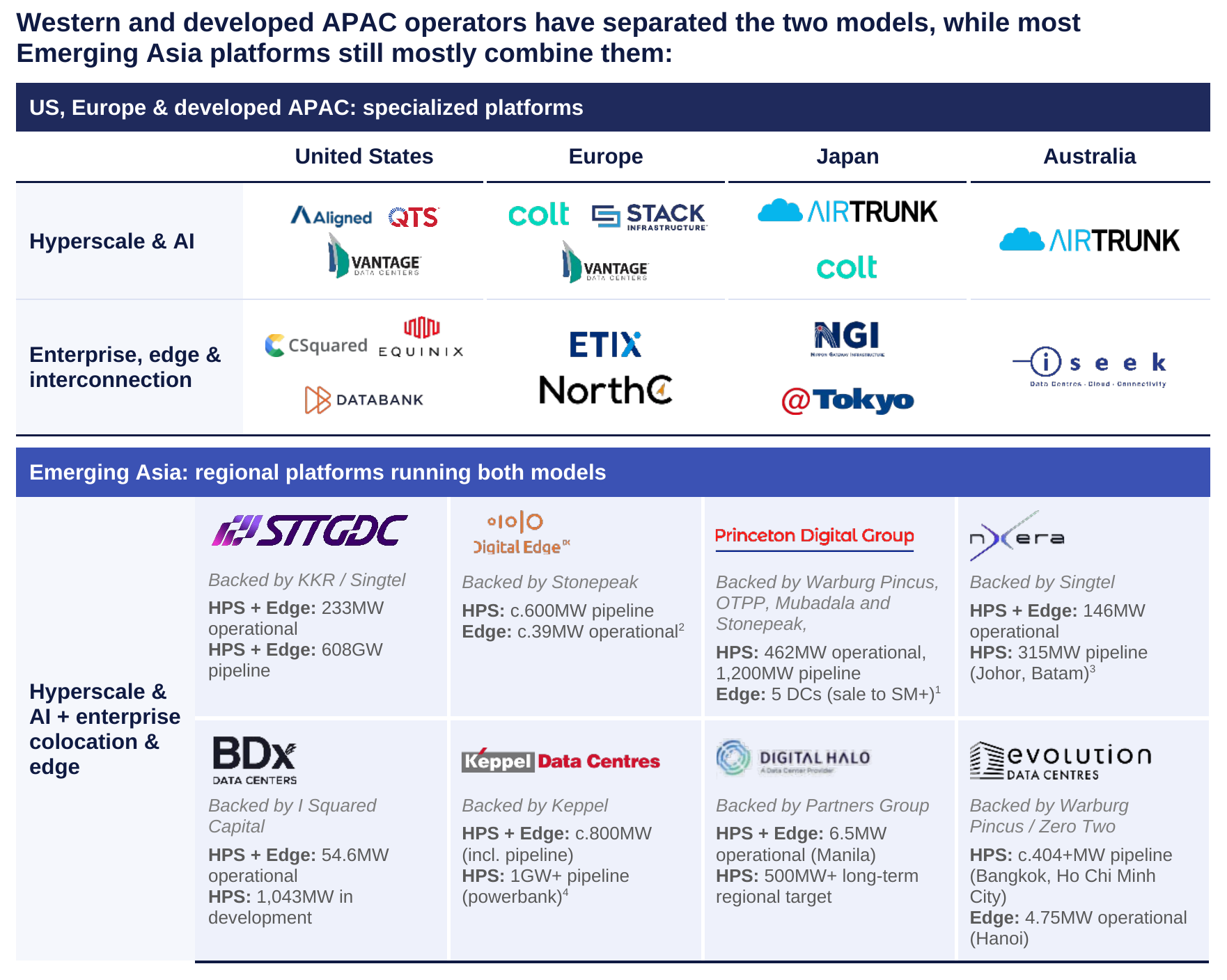
Notes: Illustrative, not exhaustive; operators classified by primary business model in each market. Emerging Asia regional platforms serve enterprise, edge and hyperscale customers on the same platform. HPS = hyperscale & AI; Edge = enterprise, edge & interconnection; pipeline = under construction or planned. Approximate IT load as of 2026; figures are group-wide unless a market is stated. 1) PDG agreed in October 2026 to sell its Indonesian enterprise data centers to SM+ and now focuses on hyperscale. 2) Sum of disclosed IT capacity; the other sites are excluded for lack of disclosure. Source: Company announcements and press reports; DC Market Insights; Index Partners analysis. 3) According to Singtel Digital disclosure. 4) Gross power MW
Data center debt financing is becoming more selective and expensive as lenders reassess their exposure to the sector. Banks and private credit funds are becoming more selective as their sector exposure grows and concerns mount over neocloud creditworthiness and early termination rights in customer contracts. These pressures are contributing to rising borrowing costs, with at least 18 data center financings now reportedly carrying double-digit yields. ING is also reportedly seeking to sell USD500m of data center loans as part of its exposure management. [15][16][17]
Tighter market conditions are also affecting equity fundraising, with APAC data center operators delaying IPOs, reducing fundraising targets, or exploring stake sales. Blackstone-backed AirTrunk reportedly postponed its Singapore REIT listing, while Nvidia-backed Australian AI cloud provider Firmus shelved an IPO targeting a valuation above USD30bn. DayOne is reportedly considering delaying or downsizing its US IPO from USD5bn to USD2.5–3.0bn. Meanwhile, STT GDC India's shareholders are exploring a stake sale as part of a broader portfolio realignment. [15][18]
Despite tighter financing conditions, demand for capacity remains strong, with development pipelines continuing to expand and requiring substantial capital investment. In 2026, PDG arranged approximately USD856m of financing for its 120MW JC3 campus in Greater Jakarta, while Digital Edge and B.Grimm Power secured USD880m of green financing for a 100MW campus in Thailand. [19][20] Operators pursuing both enterprise colocation and hyperscale expansion increasingly faces competing capital requirements, potentially limiting their ability to fund and grow both business models in parallel.
This emphasizes the need for specialization: divesting non-core enterprise colocation assets allows operators to recycle capital into hyperscale expansion without increasing debt or diluting shareholders.
We see choosing where to play between enterprise colocation and hyperscale offers Emerging Asia operators and their shareholders three benefits: an easier path to liquidity, bigger capital to invest into the core business, and a leaner operating model.
The largest buyers of data center platforms, mostly US, European infrastructure funds and strategic operators, already invest along these lines. Even when the same investor backs both models, it typically does so through separate, dedicated platforms. DigitalBridge, for example, backs hyperscale developer Vantage Data Centers, while in Asia it has acquired AIMS, Malaysia’s carrier-neutral interconnection hub, and built a dedicated enterprise colocation platform in Japan. In Europe, Apollo and Antin have built platforms focused purely on enterprise colocation through the STACK carve-out and NorthC, while Blackstone acquired hyperscale developer AirTrunk in Australia. [10][21]
In Japan, DigitalBridge and Japan Extensive Infrastructure (JEXI) acquired two data centers from NEC in March 2026 and subsequently established Nippon Gateway Infrastructure (NGI), a dedicated enterprise colocation platform. NEC remains an anchor customer, providing contracted revenues while NGI plans to expand through further acquisitions and new developments. [22]
A focused platform is also easier to explain to these buyers and to public market investors: one customer profile, one growth story, and one set of comparable companies. As the transactions below show, both specialized enterprise and hyperscale platforms can achieve strong valuations when matched with the right buyer universe.
Recent APAC transactions demonstrate strong investor appetite across both enterprise/edge and hyperscale/AI data center platforms. Enterprise/edge acquisitions have achieved approximately 15–19x EBITDA, while hyperscale/AI have attracted multiples of approximately 21–29x EBITDA. See below a selection of APAC data center M&A valuation multiples.

Notes: a) Multiple on projected EBITDA at full utilization (USD180m / 15x implies USD12.0m); standalone EBITDA not disclosed. Source: Equinix announcement, 2025 SEC 10-K. b) CY2025 forecast EBITDA of c.AUD21m. Source: HMC acquisition announcement. c) Contracted run-rate EBITDA, including capacity not yet billing (implied c.AUD1.14bn). Source: Blackstone announcement, Reuters valuation analysis. d) Forecast EBITDA; implied c.AUD77.2m on AUD1.937bn EV. Source: HMC acquisition announcement, DigiCo PDS, transaction research. e) Recalculated from annualized 9M2022 EBITDA: RM3,201.6m / [(RM83.441m − RM1.680m) × 12/9]. Source: TIME dotCom shareholder circular, pp. 11, 30 and 35; TIME transaction announcement.
The gap in multiples reflects the different economics of each model rather than a discount on enterprise assets. Edge platforms often earn roughly twice as much EBITDA per MW as hyperscale campuses, so a lower multiple would still delivers a high value per MW, while hyperscale platforms trade on higher multiples for their long-term contracts, tenant quality, and expansion pipelines. Specialization lets each platform be priced on the right metric and against the right peers. A mixed portfolio blends two different client portfolios, risk and capital profiles, making it harder for investors to benchmark, and buyers often discount the multiple to reflect that complexity.
For operators and their backers, this is particularly relevant when preparing for an exit. A platform combining mature enterprise facilities with hyperscale developments may be difficult to market to a single buyer, given differences in customer profiles, growth prospects, capital requirements, and operating risks. Therefore, divesting selected non-core assets in advance of a platform exit can simplify the investment proposition and increase the value for existing shareholders.
Beyond facilitating an exit, selective divestments can also free up capital for priority developments and reduce future equity funding requirements. With debt markets more selective, proceeds from mature enterprise assets can be a cheaper source of funding for hyperscale developments than new equity or high-yield debt.
The two models also require different organizations. Enterprise colocation often relies on a broader salesforce, customer service, and network partnerships to serve hundreds of customers, while hyperscale relies more on land and power origination, large-scale construction, and the negotiation of long-term contracts with a handful of tenants. Separating the two allows operators to focus on its own customers and capabilities, with a simpler cost base.
Princeton Digital Group’s divestment in Indonesia is the clearest example of this shift in Asia so far. In October 2026, PDG signed an agreement to sell five operating enterprise data centers across Greater Jakarta, Bandung, Surabaya, and Pekanbaru to SM+, a digital infrastructure platform backed by Indonesian conglomerate Sinar Mas. PDG acquired the facilities when it entered Indonesia in 2019. Since then, it has built a c.398MW hyperscale portfolio in Indonesia, comprising c.38MW of operational capacity at its JC1 and JC2 campuses and a c.360MW development pipeline across the JC2 expansion, JC3, and JC4. The divestment reflects PDG’s decision to concentrate on serving the growing infrastructure requirements of hyperscale customers and comes as the company lines up funding for its development pipeline. [13][23] For SM+, the transaction supports a different strategy. Following completion, the company expects to operate 31 data center sites across 25 Indonesian markets, expanding its enterprise infrastructure and connectivity network. [24]
The transaction illustrates how the same assets can serve different strategic priorities under different ownership. PDG can focus resources on larger hyperscale developments, while SM+ gains established facilities, customer relationships, and geographic coverage to strengthen its domestic infrastructure network.
As APAC’s data center market matures, we expect more operators to follow, as large platforms such as PDG and STT GDC are reportedly reviewing their portfolios and funding options. [23][18] Hyperscale developers may monetize mature enterprise facilities to fund expansion, while specialized operators could then consolidate these assets into larger networks. For shareholders and financial sponsors, portfolio optimization offers an opportunity to improve capital allocation while building a more focused and attractive platform to prepare for a future exit
We have been working on transactions of this type. If this is relevant to your portfolio, funding, or exit plans, feel free to contact the Index Partners team to discuss how you could achieve your goals